
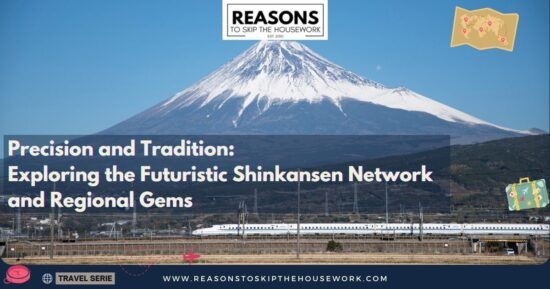
Steel Before Speed
Before departure, there is stillness.
Platforms line up in quiet order. Digital boards flicker without urgency. People stand where they are meant to stand, though no one appears to have been instructed in that exact moment.
The train glides in rather than arrives. Its surface reflects sky and platform in clean lines. Doors open. Passengers step off first. The exchange takes seconds, yet it feels unhurried.
Inside, the cabin holds a steady tone — seats aligned, overhead racks uncluttered, windows framing whatever will pass next.
The speed is known, but not yet felt.
Movement That Barely Disturbs
Once the Tokyo to Osaka train begins its westward motion, the city thins almost politely, towers lowering into suburbs before dissolving into fields and low mountain ridges that appear in softened layers.
Inside the carriage, nothing shifts abruptly. A drink rests undisturbed. A phone vibrates once and is silenced. Someone closes their eyes without adjusting posture for balance.
Outside, poles flick past in clean intervals. Rice paddies reflect fragments of sky. The horizon straightens and bends again.
The precision of the network reveals itself not through display, but through absence — the absence of sway, the absence of hesitation between acceleration and glide.
Stations appear, pause, retreat.
You stop anticipating movement because it never jars you.
Between Cities, Briefly
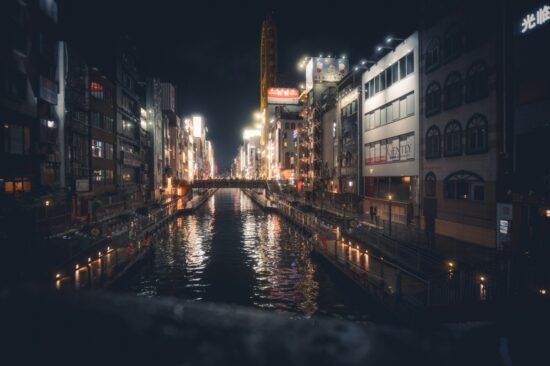
Osaka gathers gradually. Apartment towers first, then highways threading between districts, then the denser commercial core that feels layered rather than vertical.
Even here, the rhythm remains measured. Trains slide beneath buildings. Platforms open into concourses that move people forward without compressing them.
The network does not dominate the city. It threads through it.
Short Distance, Subtle Shift
Later, the Osaka to Kyoto train travel feels almost transitional rather than directional, carrying you north through neighbourhoods that loosen their density before tightening again near smaller stations.
The journey is brief enough that you barely settle. The carriage hum remains constant. Outside, industrial edges give way to residential clusters, then to glimpses of older rooftops that sit lower against the skyline.
The shift is tonal rather than dramatic.
Kyoto at Ground Level
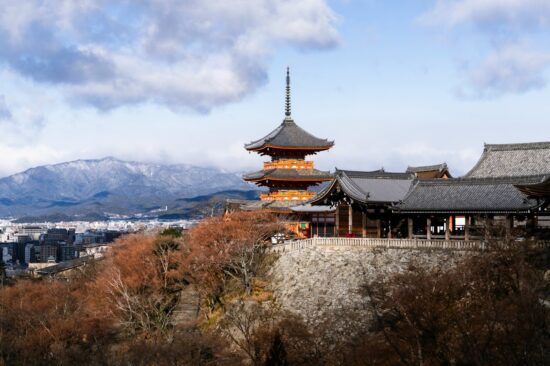
Kyoto does not rise in glass. It remains closer to ground. Temple roofs lift gently at their corners. Wooden façades line narrower streets. The scale feels contained.
You walk through districts where the rhythm slows without announcement. Courtyards sit behind walls that do not advertise themselves. Gravel absorbs sound. Sliding doors open and close with quiet restraint.
The modern network that delivered you here recedes almost immediately into background.
Precision brought you quickly. Tradition holds you still.
Regional Spaces Between
Beyond the major corridors, smaller stations continue the same choreography. Doors open. People step aside. Announcements pass overhead without volume.
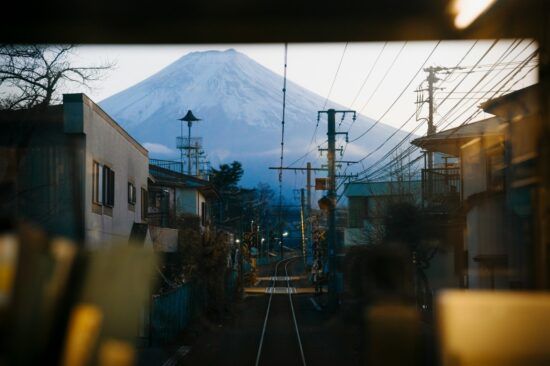
The Shinkansen lines intersect with regional routes that feel less accelerated but equally composed. Mountains approach, then retreat. Rivers cross beneath bridges without spectacle.
The infrastructure does not interrupt the landscape. It adjusts around it.
You begin to sense that futurism here is less about appearance and more about alignment — trains arriving exactly when expected, platforms holding space without clutter, motion continuing without friction.
After the Departure Board Clears
Later, when the sequence compresses in memory, the high-speed stretch between Tokyo and Osaka feels almost weightless, while the short ride north to Kyoto feels like a quiet exhale.
What remains is steadiness — the smooth forward pull, the faint vibration beneath your feet, the way cities rearranged themselves outside the window without demanding attention.
Precision and tradition do not compete along these tracks. They move in parallel.
The train departs again somewhere beyond the frame. Mountains soften. Rooftops lower.
And the line continues forward, carrying glass towers and wooden eaves along the same corridor, without insisting that either define the journey.